Gutter Math Made Simple: The DIY Installation Guide for Edmond Homeowners
Gutters are not glamorous. They do not add curb appeal the way a fresh coat of paint does, and nobody ever compliments a neighbor on a well-executed downspout. But gutters are the silent workhorses of a home, and getting them wrong is a fast track to foundation cracks, basement mold, and soil erosion that can cost thousands to repair. The good news is that a DIY gutter installation is one of the most accessible exterior projects a homeowner can tackle. Materials run between $2 and $6 per linear foot, and a typical house can be completed in a weekend. The bad news is that most first-timers get tripped up by the math. Slope calculations, downspout spacing, and drainage distance feel intimidating when you are standing on a ladder with a chalk line in one hand and a drill in the other. This guide translates those numbers into plain English. By the time you finish reading, you will know exactly how to measure, plan, and install gutters that move water away from your home like a professionally engineered system, without paying professional prices.
But before you read too far, you can contact us today to schedule your FREE evaluation and help decide if a DIY approach is best for your property.
Why Gutter Math Matters More Than You Think
A gutter system is a gravity-powered water highway. When the math is right, rainwater flows smoothly from the roof to the downspout and away from the foundation. When the math is wrong, the whole system fails, and the consequences are not subtle. Incorrect slope creates standing water in the gutter channel. That standing water adds weight to the system, accelerates corrosion in aluminum and steel gutters, and becomes a breeding ground for mosquitoes during warm months. It also freezes in winter, creating ice dams that can tear gutters off the fascia board entirely.
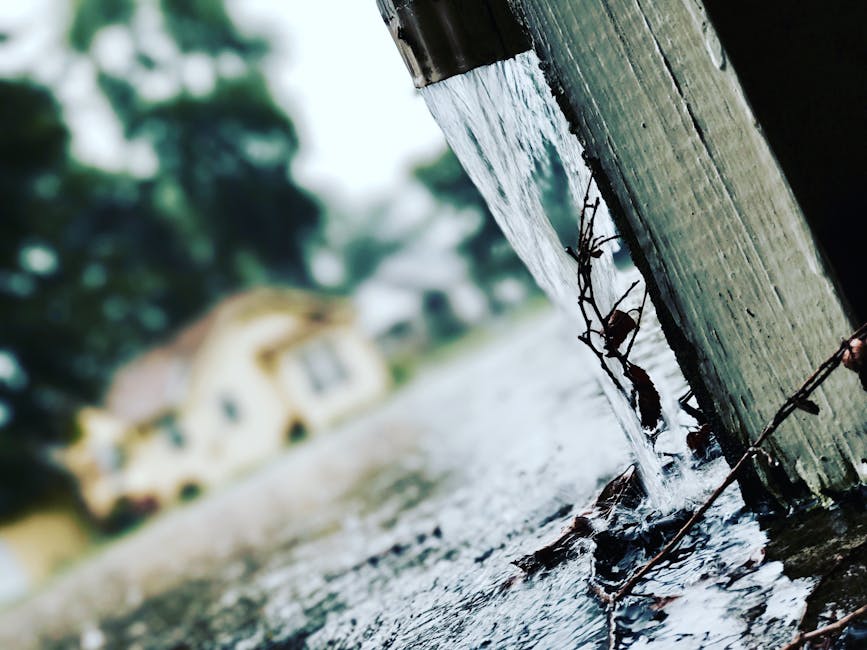
Photo by Terrance Moon on Pexels
Wrong downspout spacing is equally destructive. A gutter run that is too long for a single downspout will overflow during heavy rain, sending water cascading over the edges and straight down to the foundation. That water saturates the soil around footings, leading to settlement cracks and basement seepage. The average DIY gutter installation costs between $2 and $6 per linear foot, compared to $5 to $12 for professional installation. Getting the math right protects that investment. Most gutter failures are not material failures. They are math failures: wrong slope, wrong spacing, wrong drainage distance. Fix the numbers, and you fix the system.
The Three Numbers You Need Before You Buy Anything
Slope: The Half-Inch Rule (and When to Break It)
The standard residential gutter slope is half an inch of drop for every 10 feet of gutter run. This is the rule you will find in most installation guides and manufacturer specifications, and it works for the vast majority of homes. For a 30-foot gutter run, that means a total drop of 1.5 inches from the high point to the downspout. For a 40-foot run, the total drop is 2 inches.
Some installers recommend a quarter-inch per 10 feet for shorter runs under 30 feet. This gentler slope is less noticeable from the ground and still moves water effectively over shorter distances. The trade-off is that it leaves less margin for error. If your fascia board is slightly uneven or your hangers are not perfectly spaced, a quarter-inch slope can turn into a zero-slope section where water stalls.
Too much slope creates its own problems. A gutter pitched too steeply looks sloppy from the curb, and the exaggerated angle can cause the gutter to pull away from the fascia over time as water weight concentrates at the low end. In snow climates, a slightly reduced slope of a quarter-inch per 10 feet can help reduce ice dam pressure at low points, though this should be paired with tighter hanger spacing for added support.
To measure slope, identify the high point of the run, which is the end farthest from the downspout, and the low point, which is directly above the downspout location. Calculate the total drop based on your run length, mark both points on the fascia, and snap a chalk line between them. That line becomes your installation guide.

Photo by Nishant Aneja on Pexels
Downspout Spacing: The 30-to-40-Foot Rule
One downspout can handle approximately 30 to 40 feet of continuous gutter run. In regions with heavy rainfall, lean toward the 30-foot end of that range. In drier climates or for homes with smaller roof surfaces, 40 feet is acceptable. This rule applies to each straight run independently. A corner does not extend the capacity of a downspout. If you have a 25-foot run on one side of a corner and a 20-foot run on the other, each side needs its own downspout.
Roof area matters more than many homeowners realize. A steep roof with a large surface area sheds water faster than a shallow roof, and that water volume can overwhelm a downspout even if the gutter run is within the 30-to-40-foot guideline. Standard 5-inch gutters paired with 2x3-inch downspouts work for most single-story homes with moderate roof areas. If your roof is large, steep, or collects runoff from multiple valleys, consider 6-inch gutters with 3x4-inch downspouts, which can handle roughly 40 percent more water volume.
Place downspouts at corners and at the low points of the roofline. Do not sacrifice drainage performance for aesthetics. A downspout tucked behind a shrub looks nice until that shrub is drowning in runoff and your basement is wet. Some municipalities require downspouts every 30 feet maximum. Check your local building codes before finalizing your layout.
Drainage Distance: How Far From the Foundation
A downspout that dumps water right next to the foundation is barely better than no gutter at all. The minimum acceptable discharge distance is 4 to 6 feet from the foundation wall. For homes with clay soil, which expands when wet and shrinks when dry, extend that to 10 feet. Clay soil movement is a leading cause of foundation cracking, and keeping water away from the footing zone is the cheapest insurance policy you can buy.
Splash blocks are the simplest solution. These concrete or plastic ramps sit under the downspout elbow and direct water away from the house. They work adequately on level ground for short distances, but they are not foolproof. Heavy rain can overwhelm a splash block, and if the ground settles over time, the block can tilt back toward the foundation.
Underground drain lines are the gold standard. Rigid PVC pipe buried 12 to 18 inches deep carries water from the downspout to a pop-up emitter 10 or more feet from the house. The pipe must slope at a quarter-inch per foot to prevent clogs and standing water inside the line. For properties with poor drainage, a dry well installed 10-plus feet from the foundation provides a reservoir for heavy runoff to percolate into the soil without surface flooding. If you are integrating rain barrels, install a diverter valve and ensure the overflow outlet routes water at least 6 feet from the house when the barrel is full.
Calculating Your Gutter Needs: A Step-by-Step Approach
Measuring Your Roofline (Without Climbing Everywhere)
Accurate measurements are the foundation of good gutter math. If you are comfortable on a ladder, measure each straight run of fascia board from corner to corner with a tape measure, recording lengths in feet. For two-story homes or roofs with difficult access, aerial measurement tools like GutterScope or RoofScope+ use satellite and aerial imagery to provide precise measurements without leaving the ground. These services are worth the small fee if ladder work makes you nervous.
When measuring manually, account for overlaps at joints. Each seam between gutter sections requires 3 to 4 inches of overlap for proper sealing. If you have a 40-foot run and are using 10-foot sections, you will have three joints, each consuming roughly 3 inches of overlap. That adds up to 9 inches of additional material needed beyond the raw run length. Add a 10 percent waste factor to your total linear footage to cover mistakes, miscuts, and odd angles. Document your measurements on a simple diagram of your home's footprint. This diagram becomes your installation blueprint and your shopping list.
Choosing the Right Gutter Size for Your Roof
Five-inch K-style gutters are the residential standard. They handle the runoff from roof areas up to approximately 5,000 square feet in moderate rainfall regions. For most single-family homes, 5-inch gutters are adequate. Upgrade to 6-inch gutters if your roof area exceeds 5,000 square feet, if your roof has a steep pitch that accelerates water flow, or if you live in a region with frequent heavy downpours.
Material costs scale with size. Five-inch aluminum gutters run approximately $2.75 per linear foot. Six-inch gutters add roughly 20 to 30 percent to that cost. Downspout sizing must match. Standard 2x3-inch downspouts pair with 5-inch gutters. Six-inch gutter systems require 3x4-inch downspouts to handle the increased water volume.
K-style gutters are the most common choice for DIY installation. Their flat backs mount flush against the fascia, and their angular profile handles more water volume than half-round gutters of the same width. Half-round gutters are aesthetically pleasing, especially on older homes, but they are less forgiving of math errors and more challenging to install correctly.
Estimating Materials: What to Buy and How Much
Gutter sections are sold in 10-foot or 16-foot lengths at most home improvement stores. Menards stocks 16-foot sections, while other retailers may only carry 10-foot lengths. Longer sections mean fewer seams, which means fewer potential leak points. Buy the longest sections you can transport and manage safely on a ladder.
For downspouts, calculate one downspout location per 30 to 40 feet of gutter run, then plan for roughly 10 feet of downspout pipe per location, accounting for vertical drop and elbows. Hidden hangers should be installed every 18 to 24 inches. In snow and ice climates, tighten that spacing to 18 inches. Multiply your total linear feet of gutter by 0.5 to 0.67 to estimate the number of hangers needed.
End caps, slip joints, and sealant are the small items that stop a project cold if you run out. Plan for two end caps per gutter run, one slip joint per seam, and one tube of gutter sealant per 20 feet of gutter. For tools, an angle grinder with a cut-off wheel produces cleaner cuts on aluminum than a hacksaw or tin snips. You will also need a rivet gun, a chalk line, a drill, and a 4-foot level.
The Installation Math: Putting Numbers Into Action
Marking Your Slope With a Chalk Line
The chalk line is your single most important installation tool. It translates your slope calculation into a visible guide that runs the full length of the gutter run. Start by marking the high point on the fascia, which is the end farthest from the downspout. Mark the low point directly above the downspout location, accounting for your total calculated drop. For a 40-foot run at half an inch per 10 feet, the low point is 2 inches below the high point.
Snap the chalk line between these two marks. Before you install a single hanger, place a 4-foot level against the chalk line at several points along the run to verify that the slope is consistent and that you have not introduced any low spots. A common mistake is assuming the fascia board itself is level. Fascia boards often follow the roofline, which may have subtle dips or rises. Always measure from the chalk line, not the fascia.
Cutting and Joining Gutter Sections
Aluminum gutters cut cleanly with an angle grinder and a cut-off wheel. The cut is fast, the edges are burr-free, and there is less risk of deforming the gutter profile compared to tin snips or a hacksaw. Wear eye protection and gloves. Aluminum chips are sharp and hot.
For joining sections, skip the pre-made slip joint connectors sold at home centers. They are prone to leaking and add unnecessary failure points. Instead, use the overlap technique. Cut back the front lip of the upstream section by 2 to 3 inches. Slide the downstream section inside the upstream section so that water flowing downhill moves over the joint, not into it. Apply a continuous bead of gutter sealant to the inside of the overlap before joining. Secure the joint with three rivets: one at the top, one at the bottom, and one in the middle of the back wall. The sealant creates the watertight barrier, and the rivets provide mechanical strength.
Hanger Spacing and Installation
Mark hanger locations every 18 to 24 inches along your chalk line. Hidden hangers install behind the front lip of the gutter, making them invisible from below once the gutter is in place. Each hanger should be attached to the fascia with a 2-inch stainless steel screw driven into solid wood. If the screw spins without biting, you have hit a gap or only caught the siding. Move the hanger slightly and try again.
For homes without a traditional fascia board, such as those with tile roofs or exposed rafter tails, use rafter-mounted hangers that attach directly to the roof decking. These hangers are more expensive and more time-consuming to install, but they are the only reliable option when there is no fascia to anchor into. After installing all hangers, test each one by pulling downward with moderate force. If a hanger flexes more than a quarter-inch, add a screw or relocate it.
Downspout Installation and Drainage Math
Positioning and Attaching Downspouts
The downspout outlet hole is cut into the bottom of the gutter at the low point of each run. Use a hole saw or tin snips to create the opening, following the template provided with the downspout outlet fitting. Attach the outlet fitting with sealant and rivets before hanging the gutter section, as it is easier to work on the ground than from a ladder.
Downspouts should maintain a slight downward angle as they run along the wall. A perfectly vertical downspout can cause water to pool in the elbows, especially during light rain. Use two 45-degree elbows instead of a single 90-degree elbow at each bend. The gentler angle reduces turbulence and clogging. Install downspout straps every 6 to 8 feet of vertical run, anchoring them into siding or masonry with appropriate fasteners.
Before finalizing the installation, test the system with a bucket of water. Pour water into the gutter at the high point and watch it flow through the channel, into the downspout, and out the discharge end. If water stalls anywhere along the path, you have a slope or alignment problem that needs correction.
Extending Downspouts Away From the House
The final leg of the drainage system is the extension that carries water away from the foundation. Flexible downspout extensions are the cheapest and easiest option. They roll out like an accordion and can be cut to length. The downside is that they degrade in sunlight and typically need replacement every two to three years.
Rigid PVC underground drains are a permanent solution. Bury the pipe 12 to 18 inches deep, slope it at a quarter-inch per foot, and terminate it at a pop-up emitter that sits flush with the lawn. When water flows through the pipe, the emitter cap lifts and releases water onto the surface. When flow stops, the cap closes to keep debris and critters out. This system works well for properties with adequate slope away from the house.
If you are connecting to a rain barrel, install a diverter valve in the downspout. The diverter sends water into the barrel until it is full, then automatically redirects overflow back into the downspout extension. Make sure the overflow path still routes water at least 6 feet from the foundation.
You can learn more about protecting your home's foundation in our recent blog post.
Testing Your Gutter Math: The Water Test
A garden hose is the best quality-control tool you own. Run the hose at the high point of each gutter run for two to three minutes at full pressure. Watch the water as it moves through the system. Any puddle that does not drain within 30 seconds indicates insufficient slope in that section. Check every joint for drips and mark any leaks with painter's tape so you can seal them after the test is complete.
Verify that water exits the downspout extension at least 4 feet from the foundation and that it does not pool near the house. If water backs up in the downspout or spills over the gutter edge, you have a capacity problem that may require an additional downspout or a larger gutter size. The final test is the next natural rainfall. Inspect your gutters during the storm. Real-world performance under sustained rain reveals issues that a hose test can miss.
When DIY Math Isn't Enough: Professional Options to Consider
Some gutter projects exceed the scope of a weekend DIY installation. Complex rooflines with multiple valleys, dormers, or unusual angles require layout expertise that comes from experience. Second-story installations present safety risks that may not be worth the cost savings. If ladders make you uncomfortable or roof access is dangerous, consider a middle-ground approach: hire a seamless gutter fabricator to make custom-length sections on-site, then install them yourself. Seamless gutters eliminate the leak-prone joints that come with sectional systems, and the material cost is only slightly higher.
Permit requirements vary by municipality. Some local building departments require permits for gutter work that involves modifications to drainage systems, particularly if you are installing underground drain lines or connecting to a storm sewer. Check with your local building department before starting. And if your math is making you curse, step back and call a pro. A bad DIY installation costs more to fix than hiring correctly the first time.
Frequently Asked Questions About Gutter Math
What happens if my gutter slope is wrong?
Standing water leads to rust, corrosion, mosquito breeding, and eventual gutter collapse from water weight. It also increases the risk of ice dams in winter.
Can I install gutters with zero slope?
No. Even a slight slope of a quarter-inch per 10 feet is necessary to prevent standing water. A perfectly level gutter will not drain.
How do I calculate downspout needs for a complex roof?
Treat each roof plane as a separate calculation. Valleys and ridges create independent drainage zones, and each zone needs its own downspout capacity assessment.
Is 5-inch or 6-inch gutter better for my home?
Five-inch is standard for most homes. Upgrade to 6-inch if your roof exceeds 5,000 square feet, has a steep pitch, or you live in a heavy rainfall region.
Do I need a permit for DIY gutter installation?
Check your local building department. Some municipalities require permits for modifications to drainage systems, including downspout additions and underground drain lines.
Summary and Final Checklist
Before you buy materials or climb a ladder, work through this checklist. Every item represents a math decision that affects the performance and longevity of your gutter system.
✅ Measured all gutter runs and created a diagram of your roofline.
✅ Calculated slope at half an inch of drop per 10 feet of run.
✅ Planned downspout locations at one per 30 to 40 feet of gutter run.
✅ Determined drainage distance at a minimum of 4 to 6 feet from the foundation.
✅ Selected gutter size: 5-inch standard, 6-inch for larger roofs.
✅ Purchased materials: gutter sections, downspouts, hangers, sealant, end caps.
✅ Marked chalk line with correct slope before installation.
✅ Installed hangers every 18 to 24 inches.
✅ Used overlap technique instead of slip joints for seams.
✅ Tested system with hose and during natural rainfall.
Gutter math is not complicated. It is three numbers applied consistently across your entire roofline. Get the slope right, space the downspouts correctly, and extend the discharge far enough from the foundation. Do those three things, and your DIY gutter installation will perform as well as any professional system, at a fraction of the cost.
PLEASE NOTE: While a DIY gutter install is achievable, it can also prove to be fairly difficult. If you're not confident in the installation process or simply want to learn more about our process, contact us today. We're happy to help!